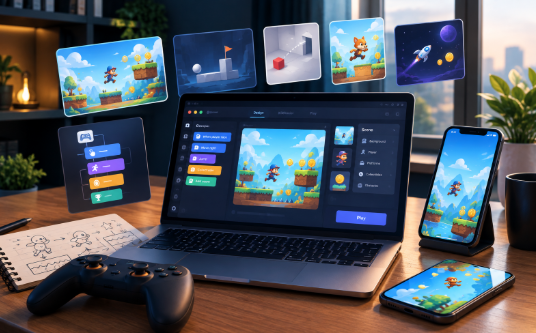

Casual games are the easiest kind to love and one of the hardest kinds to design well. Players expect to understand them in seconds, enjoy a round during a spare few minutes, and come back without any pressure. That simplicity looks effortless from the outside, but it comes from careful decisions about what to include and what to leave out. For a long time, the technical cost of building even a small casual game kept many good ideas on the shelf. No-code game makers have changed that, letting creators go from a rough thought to a playable round in a single sitting.
What Makes a Game Casual
Easy to Learn, Quick to Play
A casual game can be understood almost immediately. A new player should know what to do within the first few seconds, without reading instructions or sitting through a tutorial. Rounds are short, so the game fits into small gaps in a day rather than demanding a long block of time.
Low Pressure and Forgiving
Casual players aren’t looking for a punishing challenge. Mistakes should cost a few seconds, not an hour of progress. A forgiving structure keeps the mood light and encourages people to try again instead of quitting in frustration.
A Hook You Can Describe in One Sentence
The strongest casual games have a premise that fits in a single line. If you can tell a friend what the game is in one breath and they immediately understand why it might be fun, the concept is working. Anything that needs a long explanation is probably too complicated for a casual audience.
Why Casual Games Used to Be Slow to Build
Small Games Still Needed Full Technical Setup
Even a simple game required an engine, basic systems, and enough code to make the central action work. That setup cost was roughly the same whether the game was big or small, which meant tiny ideas carried a disproportionately high price to test.
Polish Is Harder Than It Looks
Casual games depend heavily on feel. Tiny timing details, responsive controls, and satisfying feedback are what separate a game people enjoy from one they close after ten seconds. Getting those details right traditionally took skilled programmers and many rounds of adjustment.
How No-Code Tools Speed Things Up
Describing the Game Instead of Programming It
No-code game makers let creators explain what should happen in plain language or through visual setup, and then produce a working version. A creator can say what the player controls, what they’re trying to do, and what happens when they succeed or fail, without writing the underlying logic themselves.
Seeing Results Immediately
Quick feedback is the real advantage. Instead of waiting days to see whether an idea works, a creator can look at a playable version within minutes, notice what feels off, and change it right away. That tight loop is how casual games get their polish.
Making Small Experiments Affordable
When building a version costs very little, trying a risky or unusual idea stops being a big decision. Creators can test several small concepts and keep the ones that hold attention, rather than betting weeks on a single guess.
Building a Casual Game Step by Step
Start With One Action
Pick the single thing the player will do most often, such as jumping, collecting, dodging, or tapping. Build around that action and make it feel good before adding anything else. Many casual games succeed because that one action is satisfying to repeat.
Add a Clear Goal and a Clear Failure State
Players need to know what they’re aiming for and what counts as losing. A visible score, a goal to reach, or a simple threat is usually enough. Clarity matters more than depth here, since confusion is the fastest way to lose a casual player.
Keep Rounds Short
Short rounds make it easy to say “one more try.” A round that lasts under a minute or two invites repeat play and fits naturally into busy schedules. If a round feels long, look for ways to trim downtime between actions.
Add Variety Slowly
Once the core action works, small variations, like a new obstacle, a speed change, or a different collectible, keep rounds from feeling identical. Adding them one at a time lets you see which ones actually improve the game and which ones just add clutter.
Putting It Into Practice on a No-Code Platform
A Platform Designed for Fast Casual Creation
Astrocade is a good example of a no-code game maker that fits this approach. A creator can describe a casual concept, get a playable version quickly, and share it for feedback without learning an engine first. That speed is especially useful for casual games, where the hook matters more than technical depth.
Seeing a Simple Hook in Action
Steal an Egg is a good example of a casual concept with an instantly readable premise. The title alone tells a new player what the game is about, which is exactly the kind of clarity casual audiences respond to. Games built this way show that a playful, easy-to-grasp idea can be enough to hold attention without a long list of features.
What Still Needs Human Judgment
Choosing the Right Idea
No-code tools can build a concept quickly, but they can’t tell you which concept is worth building. Picking an idea with a strong, clear hook and a satisfying core action still comes down to the creator’s taste and understanding of the audience.
Tuning the Feel
Difficulty, speed, and feedback all shape whether a casual game feels good. Tools can make adjustments easy, but deciding when something is too fast, too slow, or too punishing requires watching real people play and trusting what you see.
Knowing When to Stop Adding
Because adding features is so easy, restraint becomes a skill. Casual games usually benefit from staying small. Recognizing when a game is finished, rather than endlessly expanding it, keeps the experience focused.
Common Mistakes When Building Casual Games
Overcomplicating a Simple Idea
It’s tempting to add systems, menus, and upgrades once building is easy. For a casual game, each addition raises the barrier for new players. If a feature doesn’t make the core action more fun, it probably doesn’t belong.
Skipping Outside Testing
A game that feels obvious to its creator may confuse someone seeing it for the first time. Even a quick test with a few people who haven’t seen the game reveals unclear goals and awkward controls that you’ve stopped noticing.
Ignoring the First Ten Seconds
Casual players decide almost instantly whether to keep playing. If the opening moments are slow, confusing, or empty, many will leave before the fun begins. Getting players into the core action right away is one of the most valuable things you can do.
Chasing Polish Before the Core Is Fun
Visual effects and extra content can’t rescue a core action that isn’t satisfying. Make sure the basic loop feels good first, then polish what’s already working.
A Practical Workflow for Quick Casual Games
A reasonable approach looks like this. Write your hook in one sentence and make sure a stranger would understand it. Use a no-code game maker to build the simplest version that lets someone perform the core action and see a result. Play it yourself, then put it in front of a few people without explaining anything and watch what they do. Fix the biggest confusion or frustration you notice, retest, and repeat. Add variety only after the basic loop holds attention, and stop when the game feels complete rather than when you run out of ideas.
Final Thoughts
Casual games reward clarity, speed, and a good hook, and those are exactly the things no-code game makers help creators focus on. By removing the technical setup that used to stand in the way, these tools let people spend their time on the decisions that matter: what the player does, how it feels, and whether it’s worth doing again. For anyone with a small, playful idea, there has rarely been a quicker path from thought to something people can actually play.